Showing posts with label wildflowers. Show all posts

Thursday, 6 July 2023

Falmouth leading the way with easy access to section of South West coast path


Although the South West Coastal path runs for 630 miles the only part allowing access that meets all the requirements of the Disability Discrimination Act is found in Falmouth. Not only does this allow wheelchair users all year round access to the stunning views across Falmouth Bay, it also enables other users such as young families with prams and buggies to enjoy the scenery as well.

This unique section that runs from Falmouth’s Gyllyngvase beach to the viewing platform above Swan Pools was created in 2022. The project was a partnership of Natural England and Cormac with inputs from Cornwall Disabled, Penny Hodgson, Cormac's Countryside Ranger for the west and the Boscawen Fields Group.

Construction work that included the widening of the original footpath to allow two wheelchairs to pass each other was carried out by Cormac. The project also included the installation of new benches with adjacent space for a wheelchair to allow people to rest and take in the view.

The Boscawen Fields Group since its inception in 2014 have raised an amazing £52,500 to fund various projects that have enabled a wider range of people to enjoy the area. These include creating steps with stainless steel handrails to improve access from Boscawen Road into two of the fields that lead down to the coastal path.

The group has also funded the placement of wooden seats in two fields with a further two on the coastal footpath. Sitting on one of these on one lucky day I spotted a pod of dolphins or porpoises jumping in the Bay, a truly magical sight.

Offering panoramic views of the coast and sea, this area is a very popular part of Falmouth, with two of the fields being a favourite place for dog walkers to exercise their dogs. One field is kept dog free and in this the group funded the installation of three stone picnic tables and benches.

As well as their impressive record of fundraising, the group also carries out a variety of tasks themselves. The group meets on the first Saturday of each month to carry out litter picking and work on other projects in the Boscawen Road fields and along the coastal path.

In addition to enhancing the area for the local community and visitors alike, the group has also been involved in work to benefit wildlife such as the creation of the native perennial wildflower areas in 2019 as part of the charity Buglife’s Urban Buzz project.

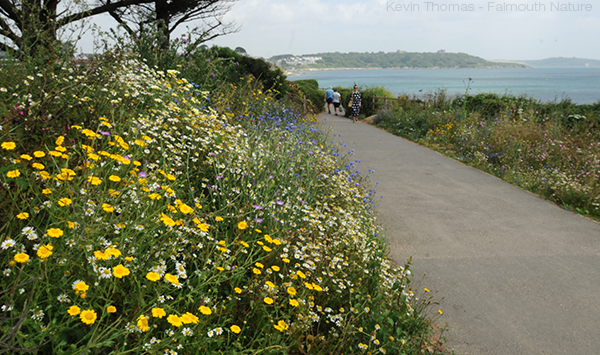
This year the group has undertaken the creation of wildflower areas alongside part of the new coastal path and from the photos who can see that they are a mass of colour. Sitting on the nearby bench I witnessed the enthusiastic reaction of walkers as they came upon them, many stopping to admire and take photographs.


Just as importantly was the constant attention they were receiving from a variety of insects such as butterflies together with both bumblebees and solitary bee species. Taking an ecological view, I was equally pleased to see a nearby hedgerow covered in bindweed flowers. Not everyone’s favourite wildflower but one that has evolved for millions of years playing its part in the web of life.

The roles that our urban green spaces play is also changing and are much more varied today than twenty years ago. Many local residents have been persuaded by people such as David Attenborough who ended Planet Earth II with the words, “It's surely our responsibility to do everything within our power to create a planet that provides a home not just for us, but for all life on Earth”.

However, we live in one of the most nature depleted countries in the world, we have lost more biodiversity than any G7 country, and we are in the worst 10% globally. Perhaps surprisingly, many towns now have more varieties of bee species than are found in the nearby countryside. So, adapting our green spaces can play an important part in helping wildlife to survive and hopefully one day to recover.

Although the Boscawen Fields Action Group is relatively small in size it has accomplished some impressive achievements. With support from our town council, its activities help to care for and protect this beautiful area of Falmouth for locals, visitors and Nature.

LINKS:

Boscawen Fields Action Group’s Facebook page: https://www.facebook.com/profile/100076476815163

Falmouth Nature Facebook: https://www.facebook.com/groups/falmouth.nature.uk

Falmouth Nature Instagram: https://www.instagram.com/falmouth_nature/

Falmouth Nature Twitter: https://twitter.com/FalmouthNature

Monday, 20 July 2020

Summer 2020 Guide to Falmouth's Urban Buzz meadows and wildflower indentification


This
is the second summer for our wildflower meadows and they are showing
their potential with over 30 wildflowers species appearing in various
meadows. This guide was produced as an introduction to the meadows and
to provide help to anyone trying to identify a wildflower. You can
download a free copy here, https://bit.ly/2SZRH9a


Friday, 1 June 2018

Spear-leaved Willowherb - Epilobium lanceolatum

Discovered a few of these wildflowers growing in Park Rise today. Generally it is found in open habitats, such as the base of hedges and walls in towns, waste ground, quarries and mine spoil heaps. 


Saturday, 11 November 2017

November Wild flowers

November can seem like a rehearsal for winter as the days shorten, temperatures fall and deciduous trees make their final preparations for shedding their leaves. It is not though a month entirely of gloom with Nature snuggling down to sleep through the long nights. A few wild flowers can still be found adding colour to the landscape in the milder parts of Britain.


The plants I discovered on a walk at the beginning of the month can be divided into four groups. The first would be the last remnants of species that mainly flower in September and October such as Ivy and bramble flowers. The second group are those species that take advantage of Falmouth’s mild coastal climate to flower for much of the year, examples of these would be Red Campion and Ivy-leaved Toadflax. A few individual plants of spring flowering species can be enticed into flowering in autumn by mild weather, the primroses and wood sorrel flowers I saw for example. Finally there are the winter flowering species that tend to be garden escapees for example Winter Heliotrope.

In all I spotted twelve species flowering, a reasonable count for early November.


Friday, 21 April 2017

Spring arrives

A carpet of Lesser Celandines heralds Spring

While the Met Office starts Spring on the first day of March that usually seems premature to me. Yes, there can be days that feel spring-like but others still require winter clothing. The vernal equinox and the changing of the clocks seem about the right time to start raising expectations that Winter is coming to an end.

My two favourite early spring flowers are Lesser Celandine for their bright splash of colour and the more bland Alexander for the reason that it attracts a variety of newly emerged insects to its flowers.


Male Tawny Mining Bee on Alexander flower
Mid-March is also when Queen bumblebees will awaken from their hibernation feeling in need of a good meal or several after their long sleep. One of the first to appear is the aptly named, Early Bumblebee (Bombus pratorum) but other species were also quick off the mark.

Top: Queen Early Bumblebee
Middle: Queen Buff-tailed Bumblebee
Bottom: Queen Tree Bumblebee 
I spotted my first solitary bee species on the 17th March, with more appearing as we moved into April. The first Cuckoo bee to appear was Nomada fabriciana, a striking bee with a red abdomen and black stripes.

From Top: Hairy footed flower bee
Yellow legged Mining Bee
Cliff Mining Bee
Cuckoo Bee Nomada fabriciana
We start this spring with a heightened concern over our butterflies that are showing a decline nationally and in urban areas in particular. There were also indications last year that bumblebee numbers were down and in Falmouth there seemed to be less red-tailed bumblebees about in particular. Fingers crossed that we have better weather this year to help numbers to recover. It is also essential that there will be a continuing source of pollen available to them throughout the spring, summer and autumn. To end on an optimistic note the number of Queen Common Wasps seem to have increased this spring.


Top: The first Holly Blue Butterfly spotted on 01/04/17
Middle: Queen red-tailed bumblebee
Bottom: Queen Common Wasp


Wednesday, 15 February 2017

January Wildflowers

Frost still lingered in shaded areas of

Falmouth cemetery
This was the second year I participated in the Botanical Society of Britain and Ireland’s New Year Plant. My chosen day was Tuesday, 3rd January and inauspiciously it began with a frost that lingered in shaded areas all day. The location was the old parts of Falmouth cemetery.

Primrose
Primroses can begin to flower quite early in Falmouth, a few can be seen as early as October in a mild autumn. Winter Heliotrope usually starts to flower in December and peaks in January.

Winter Heliotrope flowers possess a vanilla scent

An important source of pollen and nectar is the often maligned dandelion (above), there appeared to be less than usual about this year. Ivy-leafed toadflax (below) is a low growing plant that often grows on stone walls.


Ivy Flowers
Ivy begins to flower towards the end of August with its main period being September and October. A few flower heads were still to be seen in January.

Daises
Red Campion
Daises and red campion are both wildflowers that can be found in most months of the year. The biggest surprise of the month was discovering a single flower of Trailing Tormentil.
Trailing Tormentil flower in January
On the coastal path gorse was in flower.

Gorse